The 11 p.m. Burst Supply Line in a Sunblest Farms Two-Story
A homeowner near downtown Sunblest Farms called us at 11:47 p.m. on a Tuesday. The braided supply line under the upstairs bathroom sink had failed while the family was watching a movie. By the time someone heard the dripping through the kitchen ceiling, water had been running for roughly forty minutes. Upstairs bathroom soaked, hallway carpet saturated, kitchen ceiling drywall bowed and dripping, and the hardwood in the dining room already cupping.
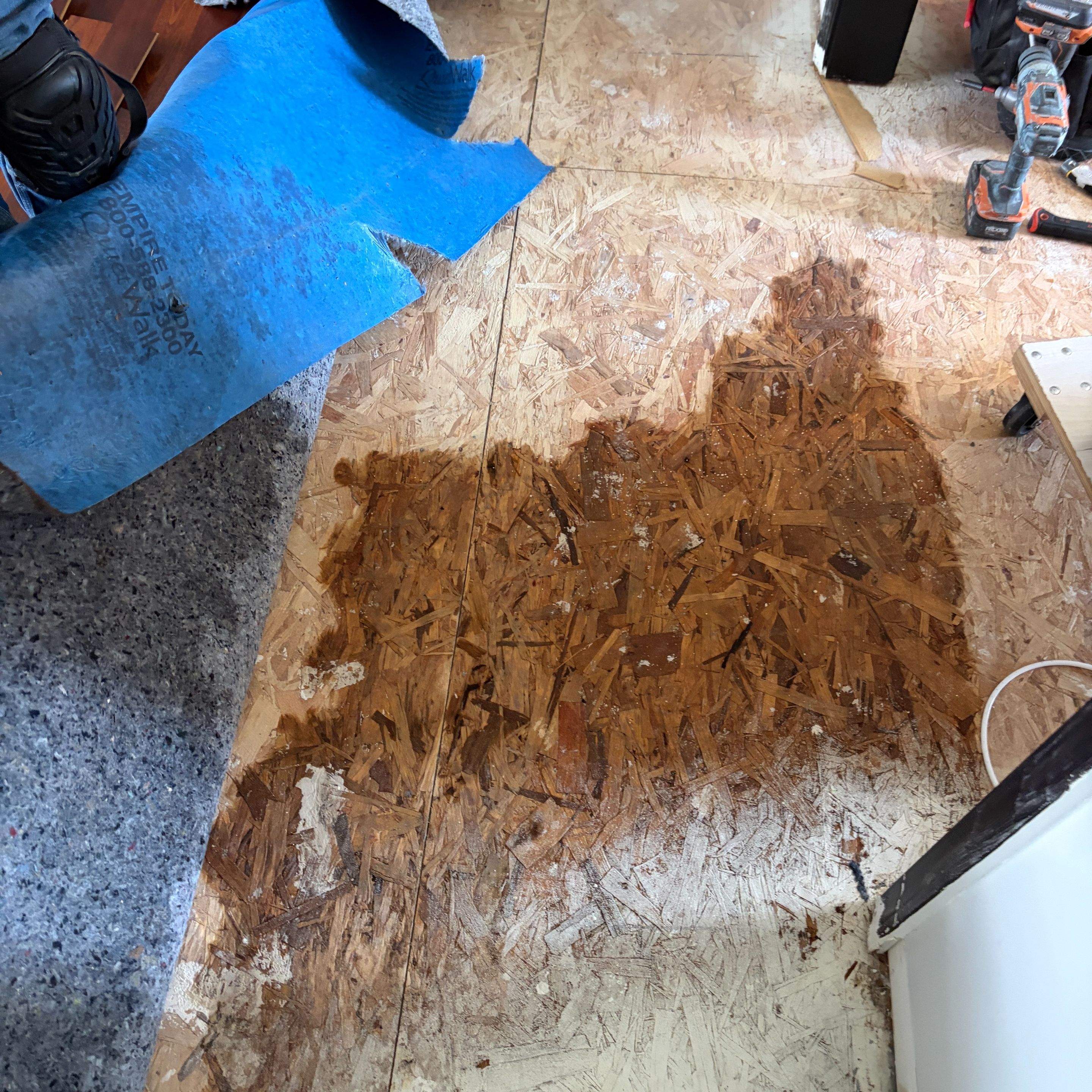
Our technician was on site in 52 minutes. First move was shutting off the main, then a moisture mapping pass with a thermal camera and pin meter. The affected footprint came in at about 680 square feet across two floors. Because the water was clean and the response was fast, we treated it as IICRC Category 1, Class 3. We extracted standing water, pulled the wet carpet pad, cut three small inspection holes in the kitchen ceiling, and set up nine air movers and two LGR dehumidifiers. Total drying time was four days with daily moisture readings.
Final invoice came to $4,920. Insurance covered everything except the $1,000 deductible. The homeowner had read our piece on first steps after water damage earlier that year, which is why she shut off the water before we arrived. That single decision probably saved her $3,000 in additional damage.
A Sunblest Farms Basement That Flooded While the Family Was on Vacation
This one stung. A family came home from a long weekend to a finished basement with four inches of standing water from a failed sump pump. The water had been sitting for somewhere between 48 and 72 hours. Drywall wicked up sixteen inches. The carpet pad was a loss. The bottom row of stored boxes, photo albums, kids' artwork, a guitar case, all soaked.
When water sits that long, the rules change. Even though the source was groundwater that started as Category 2, sitting that long with organic material pushed it toward Category 3 in several spots. We had to remove and dispose of the carpet, pad, and the bottom two feet of drywall (a flood cut). We treated framing with an antimicrobial, ran six air movers and three dehus for six days, and brought in HEPA air scrubbers because mold spotting had already started on the back of the baseboards. You can read more about why timing matters so much in our breakdown of the 24 to 48 hour mold window.
Total mitigation cost: $11,640. The rebuild (drywall, paint, new carpet, trim) ran another $9,200 through a separate contractor. Insurance paid the mitigation in full but only partially covered the rebuild because the policy had a sub-limit on basement finishes. The lesson here is two-fold. First, check your sump pump every spring. Second, read your policy before you need it.
We went back to that same house six months later to install a battery backup sump system the homeowner had ordered after the loss. He told us the new pump had already kicked on twice during a single thunderstorm in May. Backup sumps run $400 to $900 installed in the Sunblest Farms area, which is roughly a tenth of what his rebuild gap cost him. Sunblest Farms Water Restoration does not sell sump pumps, but we will tell any client who has flooded once that a backup unit is the single best dollar-for-dollar protection a finished basement can have.
What These Jobs Actually Cost in Sunblest Farms
Across the hundreds of losses we respond to each year, water damage restoration in Sunblest Farms typically lands in these ranges:
- Small clean water loss, one room, fast response: $1,500 to $4,000
- Multi-room clean water, ceiling involvement: $4,000 to $9,000
- Basement flooding, finished space: $7,000 to $18,000
- Sewage backup or Category 3 loss: $8,000 to $24,000
- Whole-home or multi-floor catastrophic loss: $25,000 and up
Three variables drive the number more than anything else: how long the water sat, what category it was, and how much of the affected material is porous. Speed of response is the only one you control. The other two are baked in the moment the loss happens.
The Carmel Sewage Backup That Nobody Wanted to Talk About
A Sunblest Farms homeowner called on a Saturday morning embarrassed to describe what was coming up through the basement floor drain. We told him what we tell everyone: this is a Category 3 loss, it is not your fault, and we have seen it more times than we can count. Sewage carries bacteria, viruses, and contaminants that make a standard dry-out approach dangerous. Anything porous that the water touched, carpet, pad, drywall, particleboard, has to go.
The job ran $8,400 for mitigation alone. We containment-wrapped the work zone, removed all affected porous materials, cleaned and disinfected with EPA-registered antimicrobials, then dried the structure over five days. Insurance covered it under his sewer backup rider, which cost him about $65 a year to add. Without that rider, he would have paid out of pocket.
That rider question comes up on almost every Category 3 call we run. Most standard homeowners policies in Indiana exclude sewer and drain backup by default, and the average claim we see in this category runs between $7,000 and $15,000. A $65 annual premium against a five-figure exposure is the kind of math that becomes obvious only after a loss. If you are reading this and you own a home with a basement or a slab drain, pull up your declarations page tonight and look for the words "sewer backup" or "water backup endorsement."
What Happens on the First Call
When you call us at 2 a.m., you get a real person, not a call center. We ask three questions: where is the water coming from, has it been stopped, and how much area is affected. We give you a rough arrival window, usually 30 to 90 minutes inside our central Indiana service area. We bring extraction equipment, moisture meters, air movers, and dehumidifiers on the first truck so we can start work the same visit. We document everything for your insurance carrier from the first minute, which makes the claim process dramatically smoother.
One Sunblest Farms client told us afterward that the most reassuring part of the night was not the equipment or the fast arrival, but the fact that the Sunblest Farms Water Restoration technician walked the house with her, pointed a flashlight at every wet spot, and explained what each tool was reading. That walkthrough takes ten minutes and changes the entire emotional tone of the loss. We do it on every job, every time.